
Attention Substack users! ETO blog posts are also available on Substack.
In this post, we trace the impact of Canada’s three main funding agencies for basic research, collectively known as the Tri-Agencies: the Canadian Institutes of Health Research (CIHR), the Natural Sciences and Engineering Research Council (NSERC), and the Social Sciences and Humanities Research Council (SSHRC).
We first consider their direct impact on research publications by finding scientific articles which contain tri-agency funding. Using patent-to-paper citations, we then find areas of innovation which build upon research funded by one of these agencies. Using the Map of Science, and our forthcoming Map of Patents, we describe the range and impact of funded works on the research and innovation landscapes.
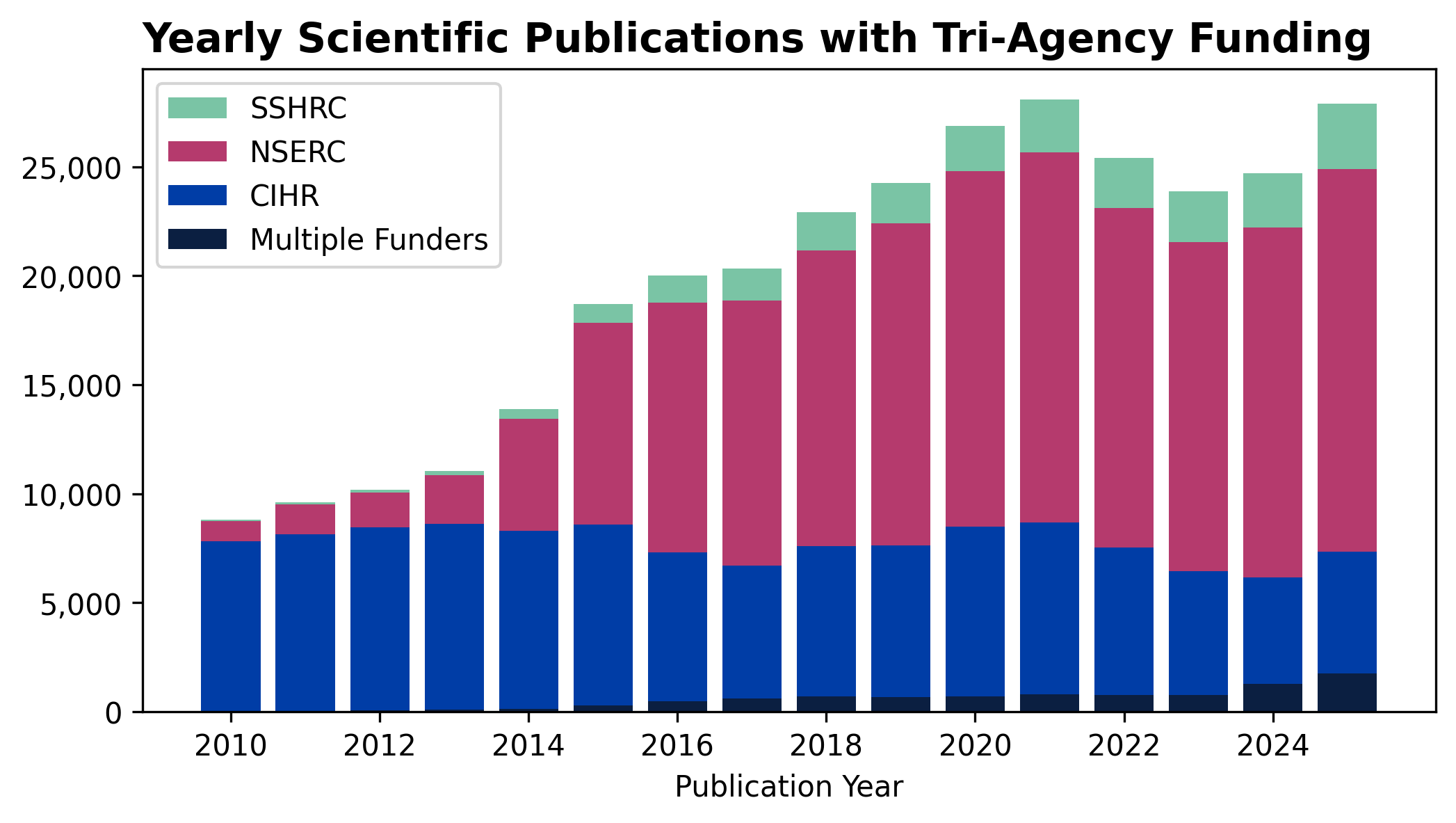
Using CSET’s Merged Academic Corpus, we identify over 334,000 papers which list one or more of CIHR (N = 130,000), NSERC (N = 187,000), or SSHRC (N = 26,000) as a funder through regular expression searches of funder organizations. Just under 3% of these papers contain funding by two or more of the tri-agencies. Notably, more papers appear to be funded by NSERC than by SSHRC and CIHR combined.
Looking at publications since 2010, we see a steady increase in overall publications, with a dip occurring around the COVID-19 pandemic. Since 2023, annual publication counts associated with all funding agencies appear to be increasing again.
Source: CSET’s Merged Academic Corpus
A key component of the innovation pipeline is patents, where inventors file a legal claim to a novel development or method. Patents cite prior works, which provide a window into transfer of scientific knowledge through to commercialization, and we obtain the patent-to-paper citations through The Lens. Individual patent documents can be filed for the same invention in multiple jurisdictions (such as with both the Canadian Intellectual Property Office and the European Patent Office (EPO)), or in the same jurisdiction for an addendum, etc. We therefore aggregate patent documents by patent families, which are unique identifiers provided by the EPO’s PATSTAT, to count by number of inventions.
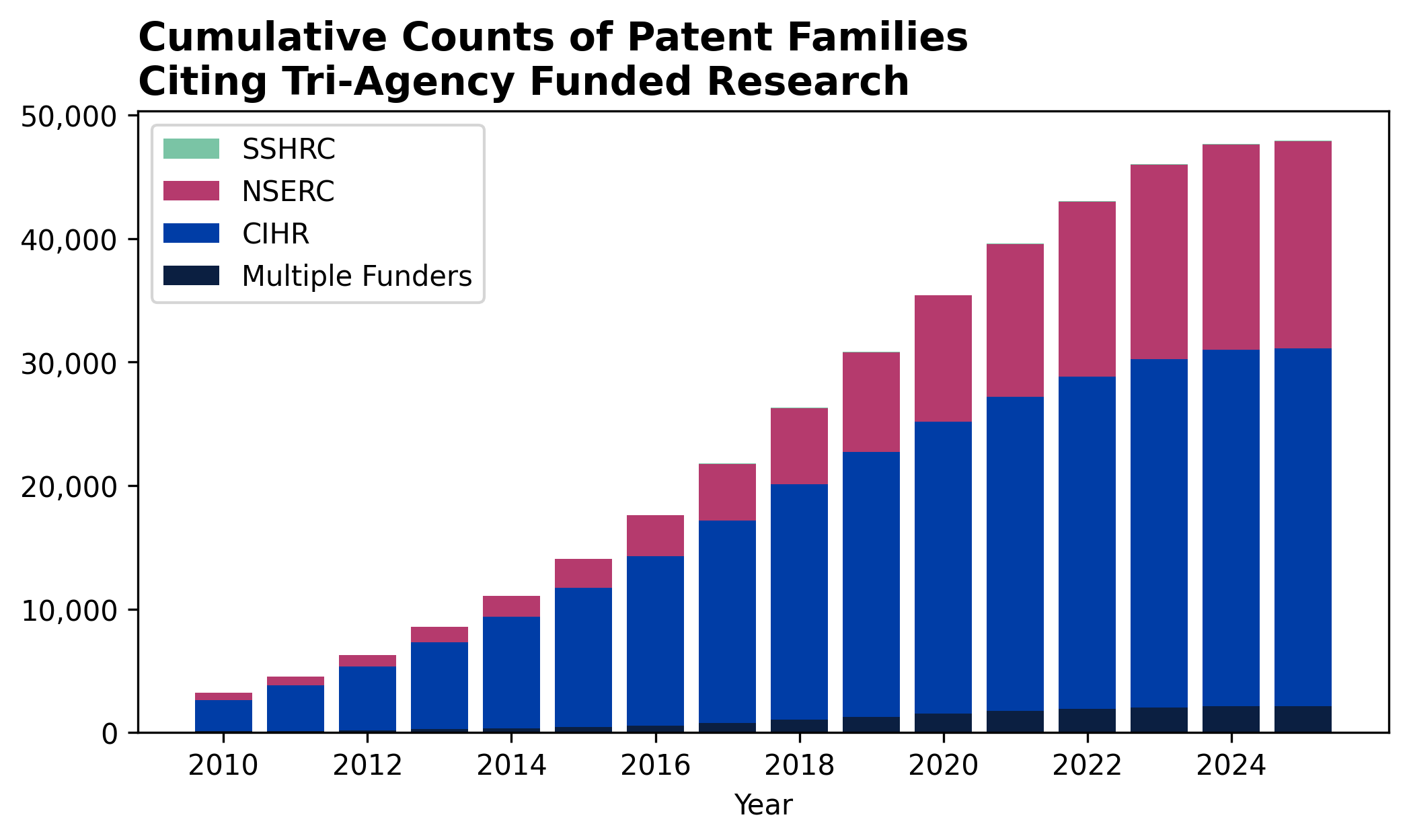
Using patent-to-paper citations, we consider the cumulative effect of the tri-agencies on scientific diffusion by counting the total number of patent families which cite a paper funded by one of the agencies. We identify nearly 48,000 such patent families. Of these, nearly 30,000 cite papers funded by the CIHR, nearly 17,000 cite papers funded by NSERC, and only 45 cite papers funded by SSHRC (with 4.4% of families citing articles funded by more than one agency or multiple articles from two or more funding agencies).
Source: The Lens and EPO’s PATSTAT
The massive number of papers and patents can make it difficult to understand more granular trends in the data. We address this issue using the Map of Science, where hundreds of millions of research articles are organized into research clusters based on citation and text similarity, as well as CSET’s forthcoming Map of Patents, where hundreds of millions of patent documents are organized into patent clusters based on citations, text similarity, and similarity of their Cooperative Patent Classification (CPC) codes.
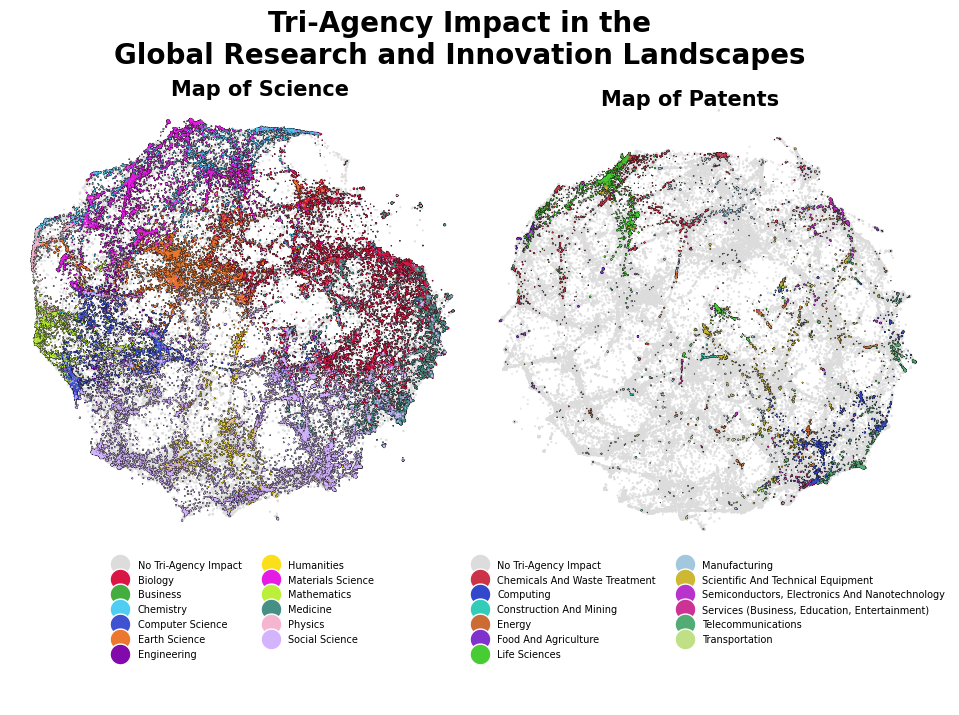
We identify research clusters in the Map of Science with papers funded by one of the tri-agencies, and patent clusters in the Map of Patents with patent families that cite papers containing tri-agency funding. The figure below highlights clusters in the maps impacted by at least one of the agencies. Notably, over half of global research clusters (53%) contain articles with funding, although only 8% of patent clusters cite research which contains funding by one of the agencies.
Source: Map of Science and forthcoming Map of Patents
The largest impact occurs in Biology (64%), Mathematics (63%), Materials Science (60%), and Physics (57%) clusters. This predominantly reflects CIHR's impact on Biology (44% of clusters contain funded work) and NSERC's contributions to Mathematics (62%), Materials Science (60%), and Physics (57%).
Although only 8% of patent clusters cite research articles with tri-agency funding, this varies considerably by area. For instance, nearly 40% of Life Science clusters in the Map of Patents are impacted by one of the tri-agencies, mostly due to CIHR (which impacts 36% of Life Science patent clusters). In addition, 17% of clusters related to computing contain tri-agency funding, predominantly due to patents in these clusters citing NSERC-funded research (16%).
We can further characterize the impact of tri-agency funded work by considering articles in research clusters that are highly cited. Although imperfect, citations provide a measure of impact, with top-cited articles generally considered more influential. We consider research clusters in the Map of Science with tri-agency funded articles in their top 90th and 99th percentiles for citations.
NSERC is particularly influential for physics, and so we can consider physics clusters in the Map of Science where an NSERC-funded research article is in the top 99th percentile. The table below provides a list of those clusters, along with a quick description of the papers contained in them, and links to the clusters in the Map of Science for more information.
As always, we're glad to help you get the most out of the Map of Science and our other resources. Visit our support hub to contact us, book live support with an ETO staff member or access the latest documentation for our tools and data. 🤖