
Attention Substack users! ETO blog posts are also available on Substack.
Guest authors Angela Wang and Isabella Delach are ETO Student Analysts at the Center for Security and Emerging Technology (CSET) at Georgetown University.
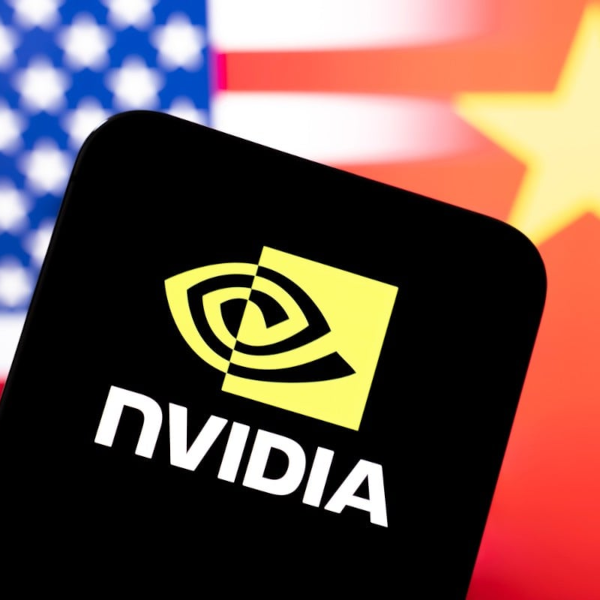
On December 8, 2025, the U.S. greenlit exports of NVIDIA's H200 GPUs to China on the condition that the U.S. government receives 25% of the chip revenue. The decision triggered debate on both sides of the Pacific. In the United States, critics warned that advanced AI chips could strengthen China's military and commercial capabilities. Meanwhile, a related debate unfolded in China: Should Chinese companies buy the H200s to accelerate its AI development, or reject them in favor of building a robust supply of domestic alternatives?
This blog post outlines arguments made in authoritative Chinese media and policy-adjacent commentary regarding whether China should purchase NVIDIA H200 GPUs to achieve immediate AI acceleration, or reject them in favor of preserving long-term autonomy.
Trump Administration Permits Limited Chip Sales to China
December 2025
According to reporting by Reuters and Bloomberg, the U.S. permitted NVIDIA to export H200 chips to a limited set of "approved customers" in China, subject to licensing and compliance requirements. The deal has a unique feature: 25% of the revenue from H200 sales to China must go to the U.S. government. Rather than a blanket export license, it combines industrial strategy with financial extraction, setting a precedent for transactional diplomacy and pay-to-play export models.
The decision sparked instant backlash in Washington. While it's not NVIDIA's most advanced chip, the H200 is a powerful accelerator that can meaningfully enhance China's military capabilities and overall economic productivity. This makes GPUs a dual-use technology, capable of being used in commercial AI applications, while also used for military modeling, intelligence analysis, and autonomous systems.
The Trump administration has defended its decision by invoking "strategic obsolescence," a relatively non-typical strategy under which the U.S. would sell obsolete, yet powerful, chips to China while retaining the most advanced and state-of-the-art chips for itself. Accordingly, the administration has allowed the export of the H200s, which lag behind NVIDIA's latest architecture by two product generations. As Jensen Huang (CEO of NVIDIA) and David Sacks (former Special Advisor for AIand Crypto) argue, this strategy has two advantages for the United States: First, it generates revenue for both NVIDIA and the U.S. government, and second, it creates long-term dependency on U.S. software by encouraging Chinese companies to develop their AI infrastructures on U.S.-based technologies.
However, Chinese online commentary claims that China has recognized this strategy. To Chinese government officials, the H200 is not a gesture of cooperation, but rather a calculated move to profit from yesterday's technology and reinsert dependency. Still, many Chinese companies, including major tech firms like Alibaba and ByteDance, hope to acquire NVIDIA's H200 chips, highlighting the central tension in China's debate over the H200.
Early 2026
This tension only deepened in the months that followed. In January 2026, the Trump administration officially approved H200 sales to China, but with significant constraints: The approval requires review by a third-party testing lab to verify the chips' technical capabilities, and sales to China cannot exceed more than 50% of the total number of chips sold to American customers.
Meanwhile, the Chinese government has authorized the sale of 400,000 H200 chips for three major Chinese companies (Alibaba, Tencent, and Bytedance), while other firms await similar approval. Even so, the licenses remain restrictive, and customers have not yet converted the approvals to actual purchase orders. Notably, Beijing is also exploring the possibility of adding a domestic chip quota tied to every H200 order.
By early February, despite the Trump administration's approval, the State Department began stalling the H200 export process by pushing for tighter regulations and conducting a national security review before granting customers licenses. Yet, as NVIDIA waited for clarity, Alibaba forged ahead with the Zhenwu810E, a high-end AI chip designed for training and inference. This move underscores China's prioritization of domestic semiconductor development.
Reactions in the Chinese Commentary
The Case for Buying H200s
Chinese firms are already capable of deploying AI across consumer platforms, logistics, finance, manufacturing, and smart devices. As such, the challenge lies not in a lack of ideas or engineering talent, but in compute at scale and training speed. Such limited access to cutting-edge GPUs forces slower training cycles and limits inference capacity, directly affecting how quickly and widely AI models can be deployed. In this way, access to top-tier GPUs determines whether Chinese AI can become a pervasive economic and military force that rivals the United States. The greatest barrier to China's AI development, then, is the availability of advanced computing power.
Authoritative Chinese commentary openly acknowledges China's high-end compute gap. A People's Daily interview in July 2025 noted that the China-eligible H200 could not meet the training needs of trillion-parameter models, highlighting the country's gap in top-tier AI compute. Securities Times also reported that training-heavy workloads still favor chips like the H100 and H200, especially as compute demand remains high.
At its core, the central claim of the "buy" camp is simple: China should acquire the most advanced GPUs to accelerate its AI progress. If not, Chinese AI development will suffer a significant disadvantage to the U.S.
The Case for Rejecting H200s
Still, regarding the purchase of NVIDIA's H200 GPUs, authoritative Chinese commentary has also expressed skepticism.
Dependency and Chokepoint Risks
While proponents emphasize speed and short-term competitiveness, there remains a significant long-term risk to purchasing H200s: re-entering a dependency cycle that China has only recently just escaped.
A different chip, NVIDIA's H20, serves as the clearest proof that access granted today can be quickly withdrawn tomorrow. Designed to comply with U.S. export controls, the H20 was powerful enough to be commercially attractive, but intentionally constrained to meet U.S. export requirements. Yet, in April 2025, the Trump administration halted H20 exports without warning, leaving Chinese firms that had built their AI infrastructure around the chip suddenly exposed. In this light, Chinese hesitation toward the H200 is not irrational, but a reflection of recent experience.
Indeed, policy-adjacent Chinese commentary treats renewed H200 access with skepticism. In a December 2025 commentary reposted by The Paper, Economic Daily argued that a temporary loosening of restrictions could not repair the underlying trust problem created by erratic U.S. policy. Chinese firms, it said, would still worry about future supply interruptions or renewed scrutiny. The same logic appears in official rhetoric: In January 2026, Foreign Ministry spokesperson Mao Ning again framed U.S. chip restrictions as part of a coercive technology policy rather than a normal commercial arrangement. That broader pattern was reflected in practice: Reuters reports that even after formal U.S. approval, H200 sales were repeatedly stalled, reviewed, or narrowed. The concern is not simply that H200 access may prove unstable, but that it would once again anchor China's AI development to a foreign chokepoint that Washington can tighten at will. Thus, many Chinese have concluded that while imported compute may be useful, they cannot serve as the foundation of China's AI future.
Imported Chips Could Crowd Out Domestic Alternatives
A second objection is that purchasing NVIDIA's H200s would undermine the development of China's domestic AI ecosystem at precisely the moment they need market scale, deployment experience, and ecosystem feedback. From this perspective, rejecting H200s is a form of trade protectionism that would advance China's technological self-reliance.
This is one of the clearest themes in policy-adjacent Chinese writing. Economic Daily argued that Chinese autonomous technology systems were moving from emergency substitution, explicitly stating that domestic AI chips had already entered official procurement lists. A People's Daily interview on H20 export loosening made a similar point: The key to escaping technological strangulation is not just acquiring foreign chips, but pushing domestic breakthroughs in architecture, manufacturing, instruction sets, and software tooling. A March 2026 theory article from the same publication also stressed that while a gap remains, China has built meaningful advantages in compute infrastructure scale and systems integration. Together, these sources frame the importance of domestic AI development, while hinting at a broader message: the presence of NVIDIA is likely to hinder market formation for Chinese firms.
Security
The third argument centers on security and trust. In July 2025, China's Cyberspace Administration formally summoned NVIDIA over alleged "backdoor" security risks in H20 chips, demanding an explanation under China's cybersecurity, data security, and personal information protection laws. In particular, Chinese state media raised concerns that foreign chips could carry surveillance, traceability, or shutdown risks unacceptable for critical internal systems. While NVIDIA denied any wrongdoing, the damage inflicted was enough to deter adoption for critical infrastructure and military modeling.
Unsurprisingly, concerns about the H20 negatively impacts Chinese perception of the H200. In August 2025, People's Daily commentary asked, in effect, how China could trust NVIDIA without convincing security proof. Even when such security claims are contested, they make it far harder for imported NVIDIA chips to be framed as neutral infrastructure.
Software Ecosystem Lock-In
The fourth objection to acquiring H200s centers on software ecosystem lock-in. Beyond hardware, NVIDIA's competitive advantage comes from its proprietary software ecosystem, CUDA. Should Chinese firms standardize on these NVIDIA GPUs, developers would build the next generation of models, codebases, and operational processes on CUDA. Importantly, this would inflate the cost to migrate workflows to domestic platforms (like Huawei's CANN system), effectively reinforcing China's reliance on U.S. technology.
This concern appears explicitly in authoritative Chinese sources. The July 2025 People's Daily interview warned that Nvidia uses CUDA to lock in customers, and argued that China must build its own developer toolchain and software ecosystem to strengthen technological diffusion and market stickiness. Business and industry coverage in Securities Times and The Paper echoes the same point from a more commercial angle: CUDA's developer community, network effects, and migration costs make switching difficult, which in turn places domestic challengers at a structural disadvantage. Once this ecosystem lens is taken seriously, the H200 debate stops being only about chip speed and becomes a debate over whether buying Nvidia hardware today deepens tomorrow's software dependence.
Conclusion
Simply put, the debate among authoritative Chinese commentary is ultimately a choice between short-term acceleration and long-term autonomy. Chinese firms clearly want access to stronger compute, and officials have not ruled that out absolutely. But much of the most authoritative Chinese commentary treats the central danger as the reconstitution of dependence on U.S. hardware, licensing discretion, and software ecosystems. That's why many Chinese analysts conclude that progress depends less on acquiring the fastest available chip and more on ensuring that the foundations of AI development remain under domestic control. These beliefs have guided Beijing to treat H200 access cautiously while subsidizing as much as $70 billion to support its local chipmaking industry.
Ultimately, examining foreign commentary in response to U.S. policy decisions offers insights into how countries respond when access to critical technology collides with the pursuit of strategic independence. We will continue to monitor commentary on this topic, and others in the emerging tech space, with Scout.
As always, we're glad to help - visit our support hub to contact us, book live support with an ETO staff member, or access the latest documentation for our tools and data. 🤖