
Attention Substack users! ETO blog posts are also available on Substack.
Robotics is a hot, growing area of innovation, everywhere from medical or AI robots to autonomous underwater vehicles to humanoid robotics. ETO’s Map of Patents lets us identify these innovation areas across robotics. With the tool, it’s easy to quickly adjust filters to find areas of interest, adjust filters to narrow your focus, and skim patent cluster titles and summaries to zero in on a preferred topic. The results allow anyone, regardless of expertise level, to quickly get a survey of a technology area and current innovations, including prominent patents, inventors, assignees, and countries, as well as recent growth, grant rates, and links to related areas and connections to the research literature.
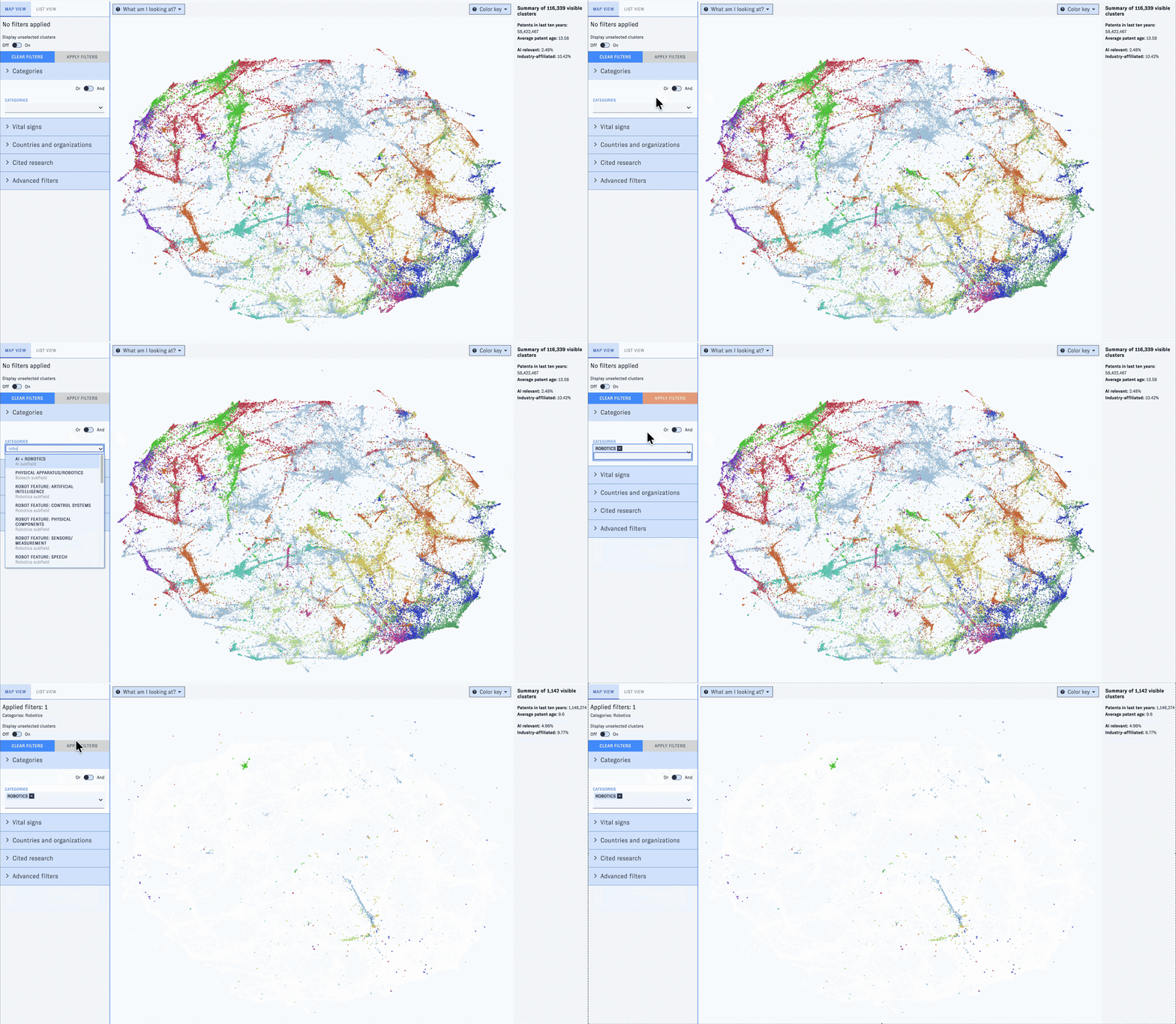
Let’s start by looking at some of the top robotics patent clusters. Once we find clusters of interest, we can explore data on key focus areas, top assignees and inventors, significant patents, recent growth, grant rates, and other indicators, making it easy to pinpoint trends and key players in the field. To identify relevant clusters, we filter the Map using the Categories option, selecting Robotics. This gives us 1,142 clusters:
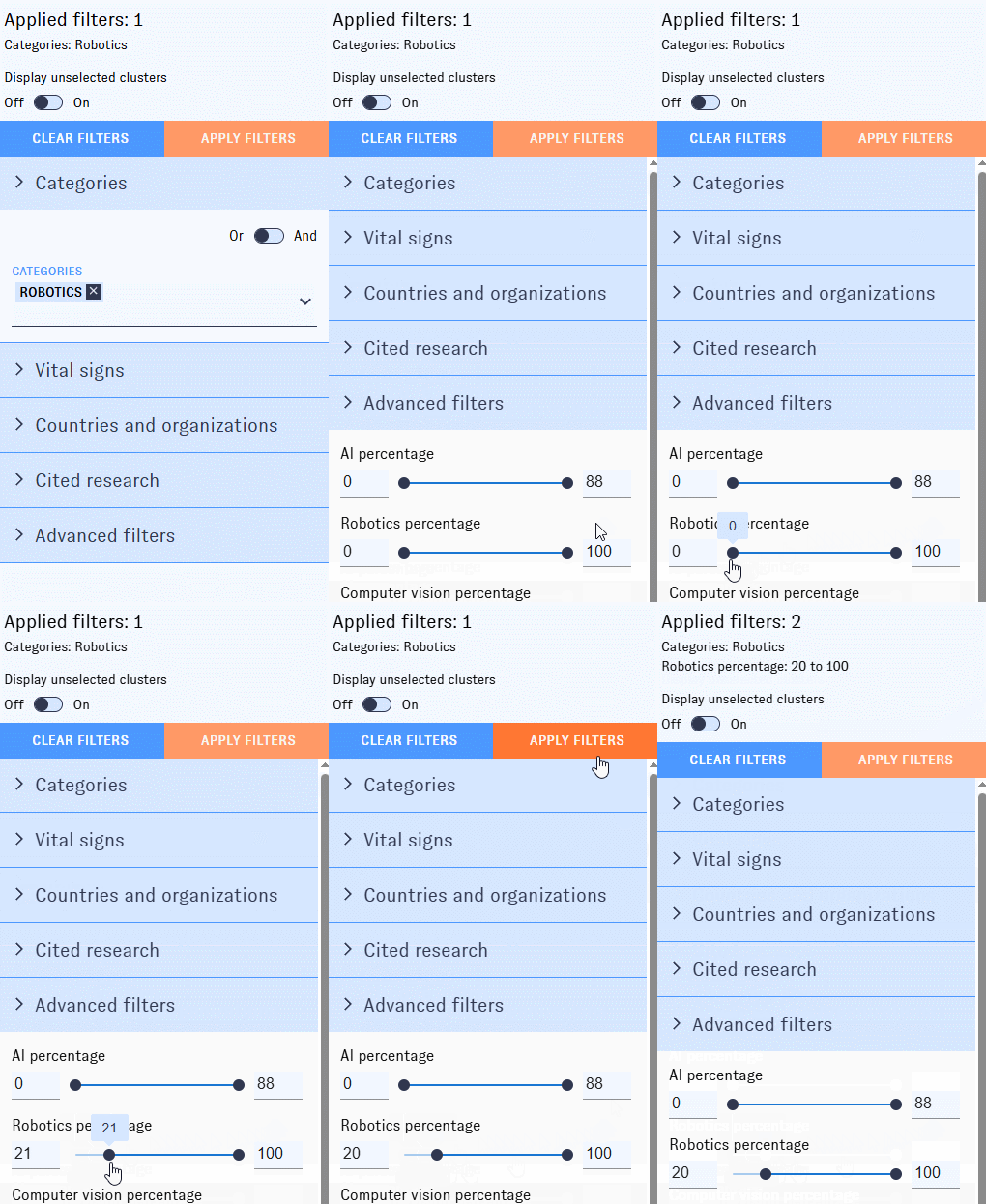
Note that this is not the only way to find robotics clusters. We can tweak exactly what percentage of the cluster we require to be relevant to robotics by using the advanced filters instead of the categories. For example, if we select only clusters that are at least 20% robotics-relevant, we get 671 clusters instead:
Once we have our selected clusters, we can explore within them, filtering and ordering them how we want. Let’s filter further here with the following criteria:
-
Only the clusters that are 20% or more robotics-relevant,
-
With 500 or more patent families in the past 10 years,
-
And a growth rating of 75 or higher, indicating that in the past 3 years, they saw faster growth than 75% of other clusters.
In plainer language, we have filtered for clusters of patents where only 20% of the individual clusters have to be robotics-related. Then we filtered by patent clusters that are robust, meaning there are a lot of patents in that cluster. Finally, we wanted to see only clusters where patents are being granted and added faster in comparison to other clusters.
These criteria will let us see large clusters with high recent growth and strong robotics relevance. The top ten of these clusters can be seen below:
Some of the filtered clusters include robotics used in medical applications (e.g. cluster 60649, Driving Assemblies for Interventional Surgical Robots) and robotics used in combination with artificial intelligence (e.g. cluster 113256, Biological Brain Models for Robot Navigation). Medical and AI robots are both hot growth areas we might expect to see well-represented in lists of large and growing robotics clusters.
Patent cluster 113256 (Biological Brain Models for Robot Navigation) is composed of 38% AI-related patents, indicating a high relevance for AI. The lead countries in this cluster, defined as the countries where the most patents are filed, are China, South Korea, and the United States, respectively, and the largest patent holders are primarily Chinese universities. However, very few industry organizations show much of a presence in the cluster. These results signal that this is an innovation area that has reached the point of potential commercial viability, showing up in actual patents and working prototypes, but may not yet have achieved wide-scale commercialization. We would expect to see more industry patents as this technology spreads into products and the marketplace.
What if we want to instead explore a particular aspect of robotics, rather than robotics in general? This is where our robotics subcategories can help. Exploring the categories menu, you will see a number of fields that begin with either “Robot Feature” or “Robot Type.” Each of these categories is referring to some aspect of robotics, a feature that a robot includes, or a type of robot. If we are interested in robots that are used underwater, we would select: “Robot Type: Underwater.”
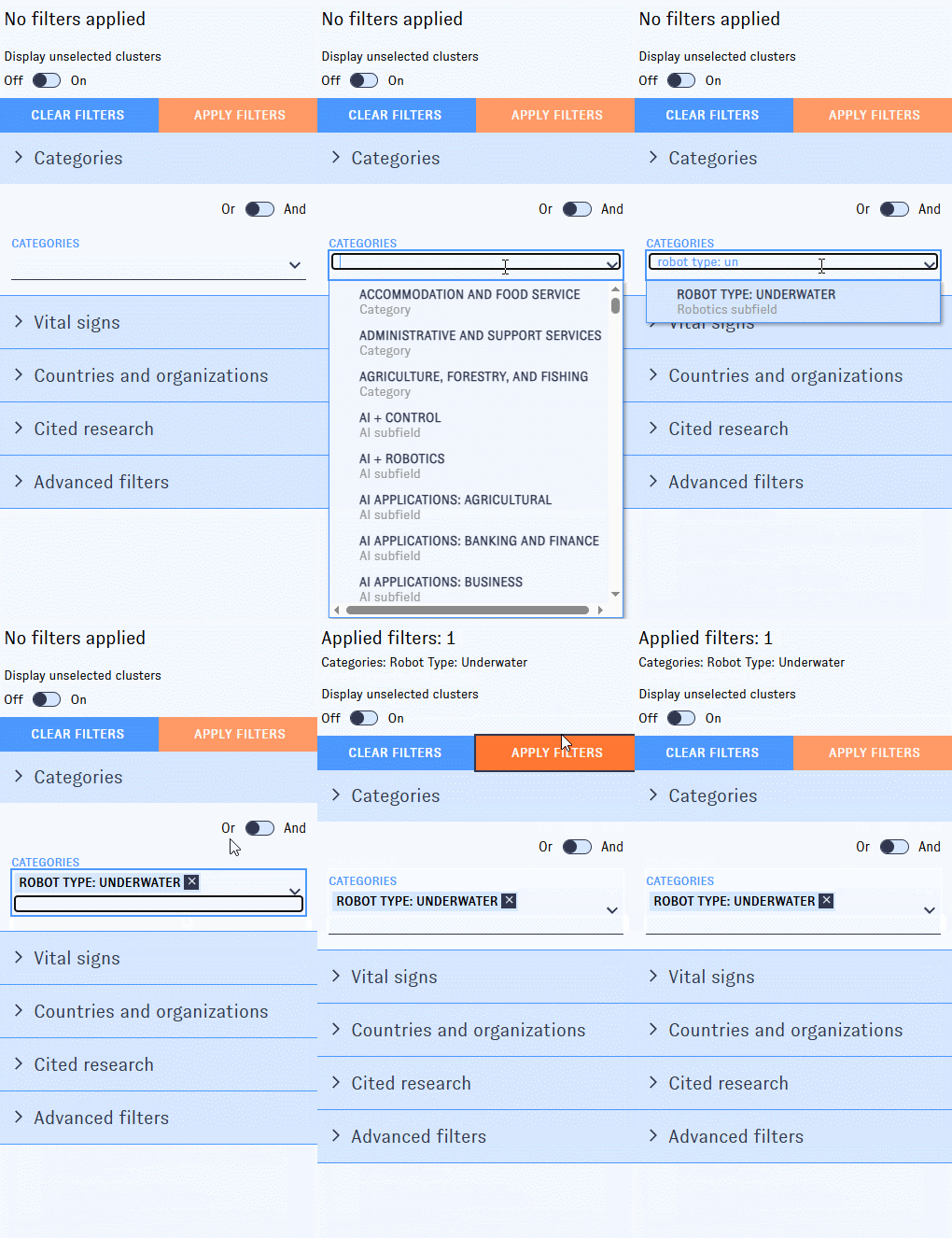
This gives us 26 clusters. We can then filter further, by limiting cluster size to be 500 or larger, and requiring the United States to be one of our top countries. After this filtering, we can again see a list of top clusters:
From this list, we can see that the primary kinds of underwater robots being developed, at least in the United States, seem to be for:
-
Maritime use, e.g. autonomous underwater vehicles, ship repair and maintenance robots, buoyancy adjustment mechanisms, and hydraulic manipulators or
-
Research use, e.g. bionic robot fish, soil and water sampling, or bridge and structure inspection
Another interesting focus area in robotics is research into humanoid or exoskeleton-type robots. The “Robot Type: Humanoid-Exoskeleton” category allows us to explore this category further. This time, let’s also filter to an average patent age of 10 years or less, since humanoid robots are a relatively new area, and this category also encompasses older areas like robotic prosthetics.
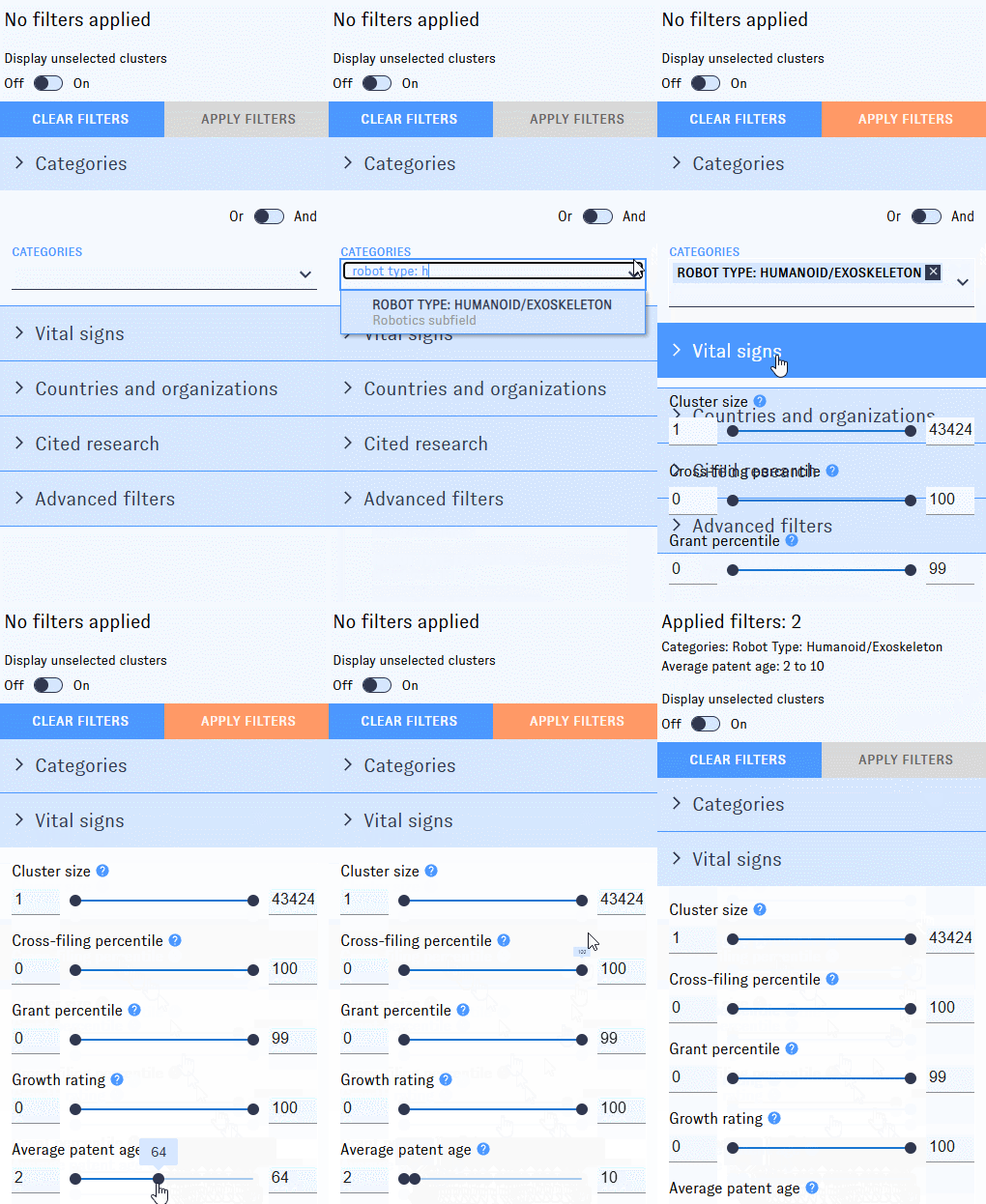
This gives us 19 clusters. If we examine the 10 largest below, we can get a better idea of what they cover:
As we are interested in identifying humanoid robot innovations, cluster 12065 (Mechanical structures for humanoid robot heads) looks particularly interesting. Exploring further, we see there have been a lot more patents in this area since 2016, and that this cluster is heavily dominated by Chinese patents. One of the prominent patenting companies in the cluster is Ubtech Robotics Corp, a Chinese company whose focus appears to be entirely on humanoid robotics.
To explore further, layer different filters together. For example, we could learn more about robots used in the mining and quarrying industries by combining Robot Type: Industrial + Mining and Quarrying. To find examples of when sensors are being incorporated into transportation robots, you can join Robot Type: Transportation + Robot Feature: Sensors/Measurement, or identify robots with physical components in use in the chemicals industry by combining Robot Feature: Physical Components + Chemicals.
And of course, we’re always happy to help. If you have any questions about the Map of Patents or our other resources at ETO, please feel free to visit our support hub, to contact us, arrange live support with an ETO staff member, or access the latest documentation for our tools and data. 🤖