
Attention Substack users! ETO blog posts are also available on Substack.
Today, the Emerging Technology Observatory is launching a major update to our Map of Science. This tool offers policymakers and researchers an open, interactive way to pinpoint key trends, hotspots, and concepts in global science and technology.
New clusters based on citations and text similarity
Previously, research clusters featured in the Map of Science were based on groups of articles that cited each other. In most cases, these groups included articles with shared topics, languages, or other connections, but in some cases a group might have included articles with wildly different themes or subjects, simply because one happened to cite another.
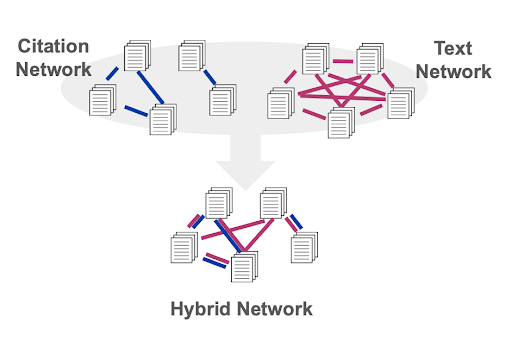
To address this issue, we’ve adopted a new hybrid clustering approach that groups articles together if they cite one another and they feature similar text in their titles and abstracts. This approach ensures that each cluster is more thematically coherent and useful for identifying related research.
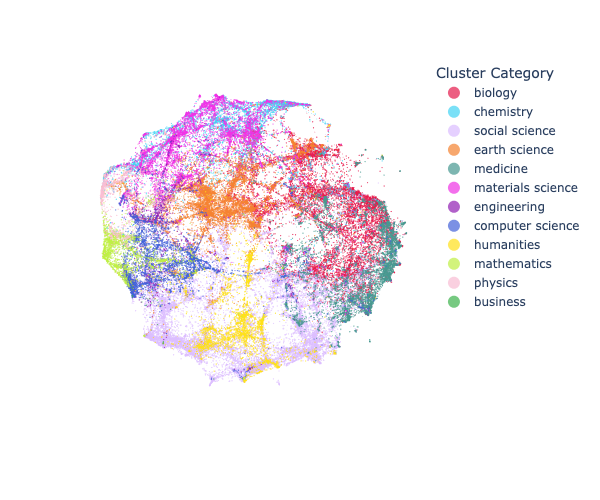
The new Map of Science features nearly 92,000 clusters. Do note that these clusters do not map one-to-one onto the previous clusters and should be considered as new, separate entities. To reflect this distinction, we’ve also updated the Map’s color scheme.
Better search functionality
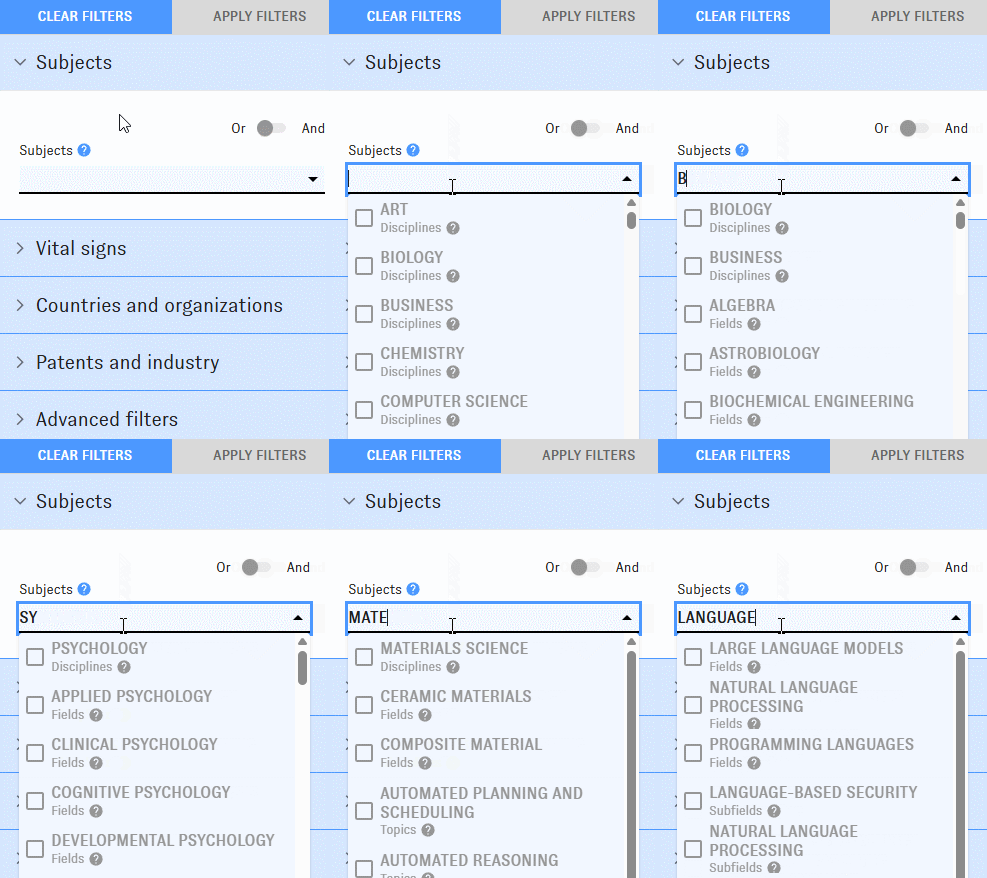
In addition to the new clusters, we’ve also improved the search functionality for the Map of Science. You can now search for clusters based on more granular research subfields and topics thanks to our newly-developed classifiers.
Shout out to CSET’s data team for developing and deploying the new hybrid clustering approach and expanded research subject classification. As always, we love feedback and are glad to help - visit our support hub to contact us, book live support with an ETO staff member or access the latest documentation for our tools and data. 🤖