
Attention Substack users! ETO blog posts are also available on Substack.
Today we're updating the Research Almanac, our dashboard for exploring trends in English-language emerging technology research. These updates build on the Merged Academic Corpus (MAC) improvements we announced last year, including more accurate author-affiliation metadata and an expanded research fields classification. As always, you can read about how we classify articles and calculate our figures in the Almanac's documentation.
Fresh data on every page
All Almanac pages have been refreshed with data covering research published between 2019 and 2024, advancing the previous range of 2018 through 2023. This marks our most current view of overall research output, growth, country shares, and citation impact yet.
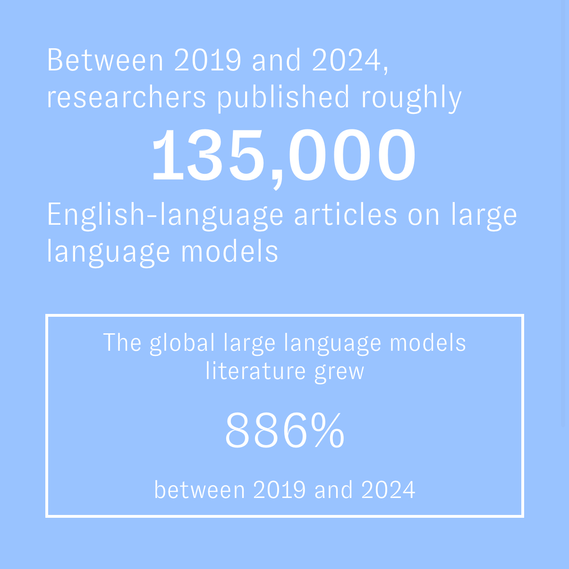
The fresh data surfaces some striking trends. For example, the Almanac now shows that researchers published more than 130,000 English-language articles on large language models between 2019 and 2024, and that this field grew 886% over that period.
New topic pages
Alongside the data refresh, the Almanac has expanded to include more than 20 topic pages, adding eleven new ones. New coverage this update includes:
- The biology topic area, from biology as a whole to applied AI subtopics spanning medicine, genetics, neuroscience, pharmacology, immunology, microbiology, cancer research, and protein modeling
- New topics within artificial intelligence, including autonomy and adversarial machine learning
- Expanded coverage of AI's role in cybersecurity, including AI + cybersecurity, AI + cyber defense, and AI + information privacy
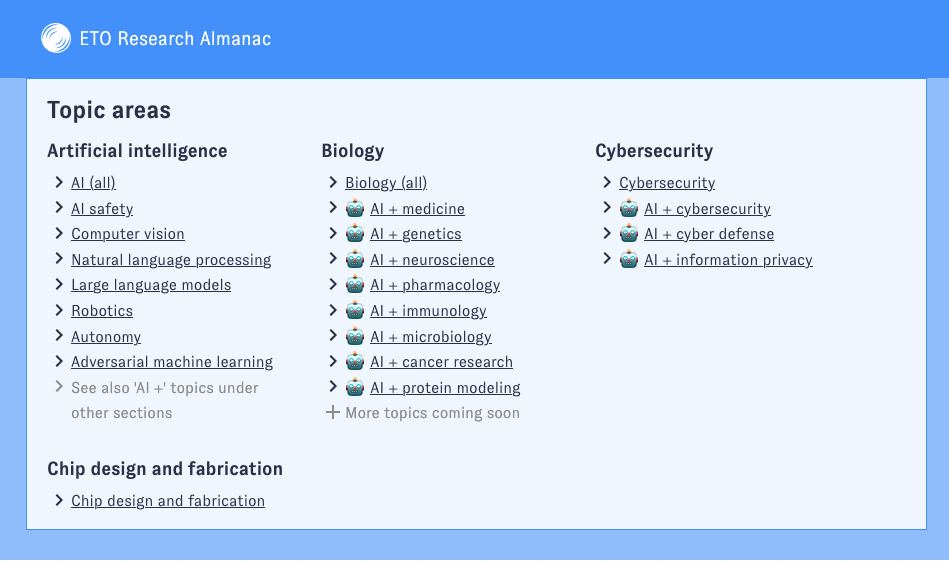
Below, we highlight a few notable findings from the new pages. You can explore all of the Almanac's topics through the navigation menu on any page.
Autonomy: fast-growing, and led by China
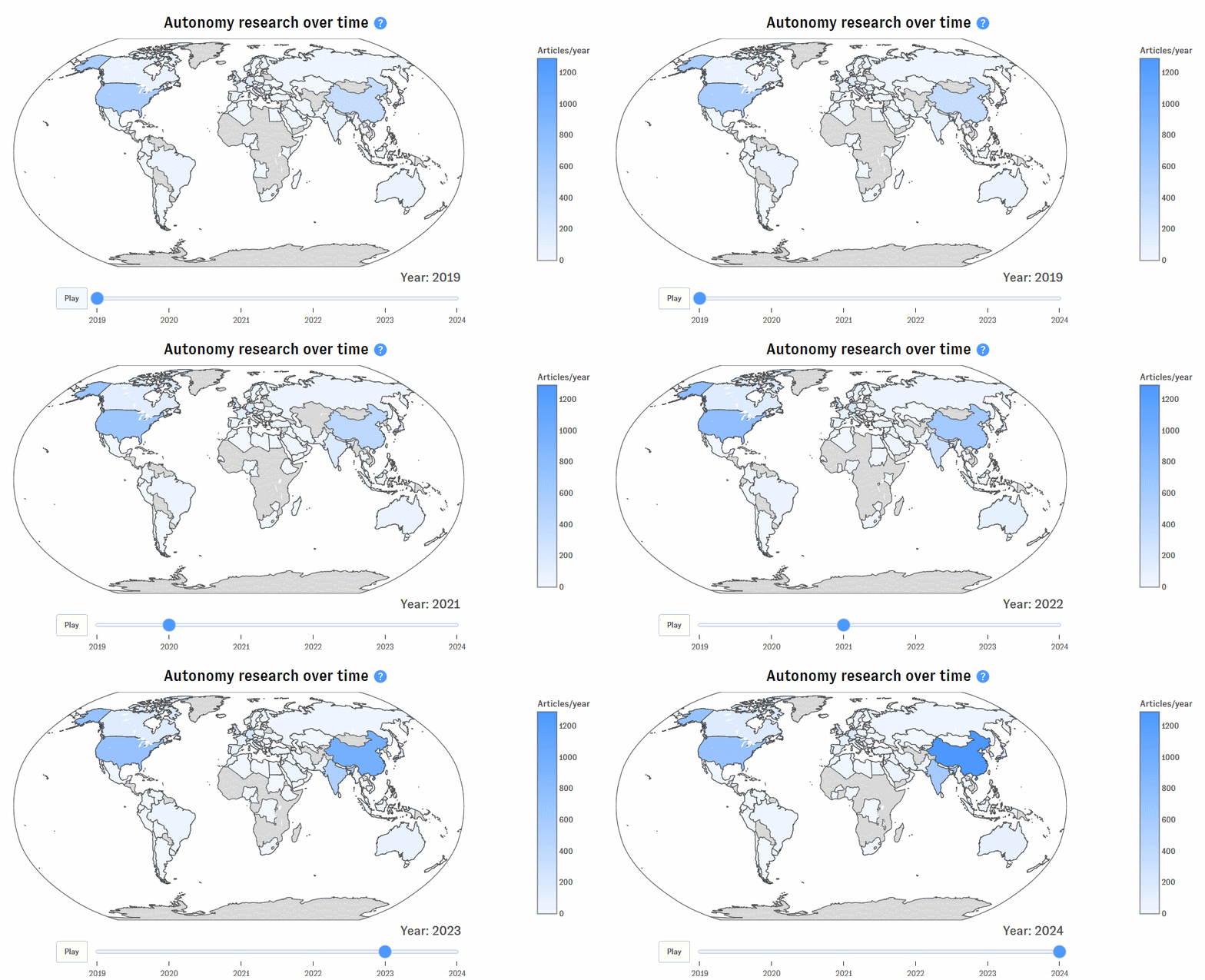
The new autonomy page covers research on self-driving technology, collaborative and multi-agent systems, and related topics. Between 2019 and 2024, researchers published roughly 23,000 English-language articles on autonomy – a slice of AI research that more than doubled over that period, growing 165%.
Country shares on the page reflect a noteworthy shift: 19% of autonomy articles have China-affiliated authors, marginally ahead of the United States at 18%, and Chinese output has grown far faster – 268% since 2019, compared with 28% growth from U.S.-affiliated authors. The two countries remain neck-and-neck among the top 10% most cited articles, each accounting for about 26%, though U.S.-affiliated articles average more citations (143) than Chinese-affiliated ones (120).
The page also underscores how much autonomy research is driven by industry: automobile and equipment giants like Robert Bosch, BMW, and Honda sit among the most prolific corporate publishers, alongside Google, Microsoft, Nvidia, and Baidu.
AI + medicine is one of the biggest slices of AI research
The new AI + medicine page documents a field that often flies under the radar: between 2019 and 2024, researchers published nearly 200,000 English-language articles on AI + medicine, growth of 213% over the period. That means roughly 10% of all English-language AI research has a medicine application – a share larger than many of the field's most-discussed subfields.
Who's producing this work may come as a surprise: 15% of AI + medicine articles have China-affiliated authors, compared with 21% from the United States, and that share has been growing rapidly over time. Industry participation is also notable. Chinese firms rank prominently among the most prolific corporate publishers, with Tencent and Ping An in the top ten, joined by medical imaging company United Imaging Healthcare alongside Google, Microsoft, Nvidia, and IBM for the United States.
The Research Almanac is available now at https://almanac.eto.tech – start with the new pages above or jump straight into a topic that interests you. As always, we value your feedback and are happy to help: visit our support hub to contact us with questions or feedback, and book live support with an ETO staff member.