
Attention Substack users! ETO blog posts are also available on Substack.
Bioinformatics, where computational methods and tools are developed to better understand large, complex biological data, is growing rapidly; we see an increase in annual publications over the last two decades. Moreover, nearly 11.9% of articles published in bioinformatics from 2025 relate to AI, up from 5.9% in 2010, showing an emerging, interdisciplinary feature in the field.
Source: CSET’s Merged Academic Corpus
The large volume of articles makes it difficult to understand granular trends in this frontier area. Using the Map of Science, where hundreds of millions of research publications are organized into research clusters based on citation and text similarity, we can find "top" areas at the intersection of AI and bioinformatics research.
We first identify topic-relevant clusters by filtering on subjects, looking for clusters in Bioinformatics. Out of the over 91,000 clusters in the Map, we find 1,449 that are of potential interest. We then isolate clusters using the filter menu to find ones that are at least 20% AI-related, whittling down our list to 110 clusters of interest.
There are many ways to identify "top" research areas in a given subject area. We filter on clusters using the size and growth concept in the Map. We consider clusters that are particularly large, with at least 500 articles published in the last 5 years. We further select clusters that are at least in the 80th percentile for growth rating in their vital signs, leaving us with 14 clusters of interest.
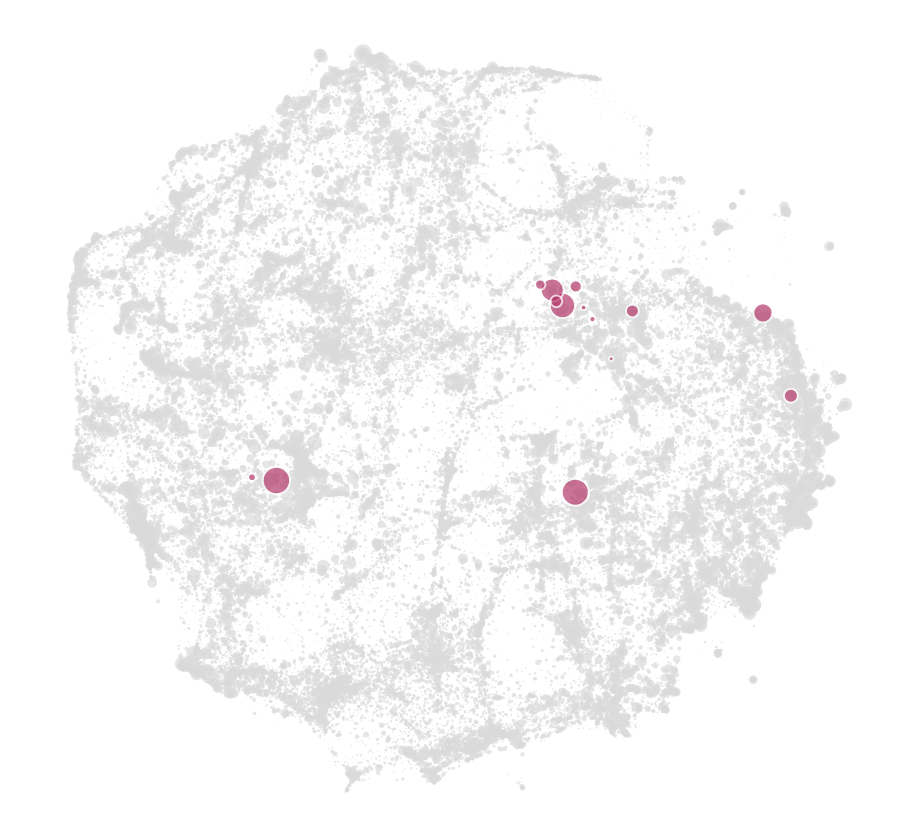
What are these clusters about? Using LLM-generated cluster titles and summaries, as well as making use of the clusters' detail views and the Map's list view for ease of analysis, we can learn more:
Looking through these clusters, we notice several themes pop out.
- Genetics: Unsurprisingly, many of the top clusters relate to genetic expression, manipulation, or prediction (11688, 22747, 28109, 46566, 58661)
- Structure and Function Prediction: Many clusters apply advanced computational and AI techniques to predict protein structure (11442), predicting and understanding antimicrobial resistance (22747, 24570), pharmaceutical compounds (29639) and antibody structure for therapeutic applications (9207)
- Cancer and Disease: Using AI to analyze images for cancer (6058), integrating multiple sources for cancer diagnosis and survival predictions (46566), processing imaging data for glioma diagnosis (20351), and researching MPox (80220)
- Multiple Data Source Integration: Combining multiple data sources for analysis (6495), including for cancer diagnosis and survival predictions (46566)
- Microbiomes: Analysing data around human gut microbiome and biological markers (56795) and understanding antimicrobial peptides in microbiome datasets (24570).
What else can we discover? Using the Map's summary view on our clusters of interest, we can find out more such as country and organization connection through author affiliation, and document information from article sources. For instance, some of the major sources of articles in these clusters come from the bioRxiv and the arXiv, indicating that many of the articles in these clusters are pre-prints, a reflection of how recent the research activity is. Authors are predominantly affiliated with China or the United States. The most highly cited articles across these clusters is related to AlphaFold, the pivotal AI system to predict protein structure.
As always, we're glad to help you get the most out of the Map of Science and our other resources. Visit our support hub, to contact us, book live support with an ETO staff member or access the latest documentation for our tools and data. 🤖